언어-유희 편집부 · 2026-07-29 · EN / KR
How to Build a Loc Kit Translators Can Actually Use
Extracted strings alone are not a Loc Kit. Shared schema, chronological order, speaker/context, and clear branching markers decide whether translators can actually start.
번역가가 바로 일할 수 있는 Loc Kit 만드는 법
단순히 게임 파일에서 번역할 원문을 뽑았다고 Loc Kit이 되는 것은 아닙니다. 원문 이외에도 제대로 된 구조, 즉 출력 순서, 짧은 맥락에 관한 메모, 키값, 화자 정보 등이 있어야 제대로 된 번역을 할 수 있는 loc kit이 갖추어졌다고 할 수 있습니다.
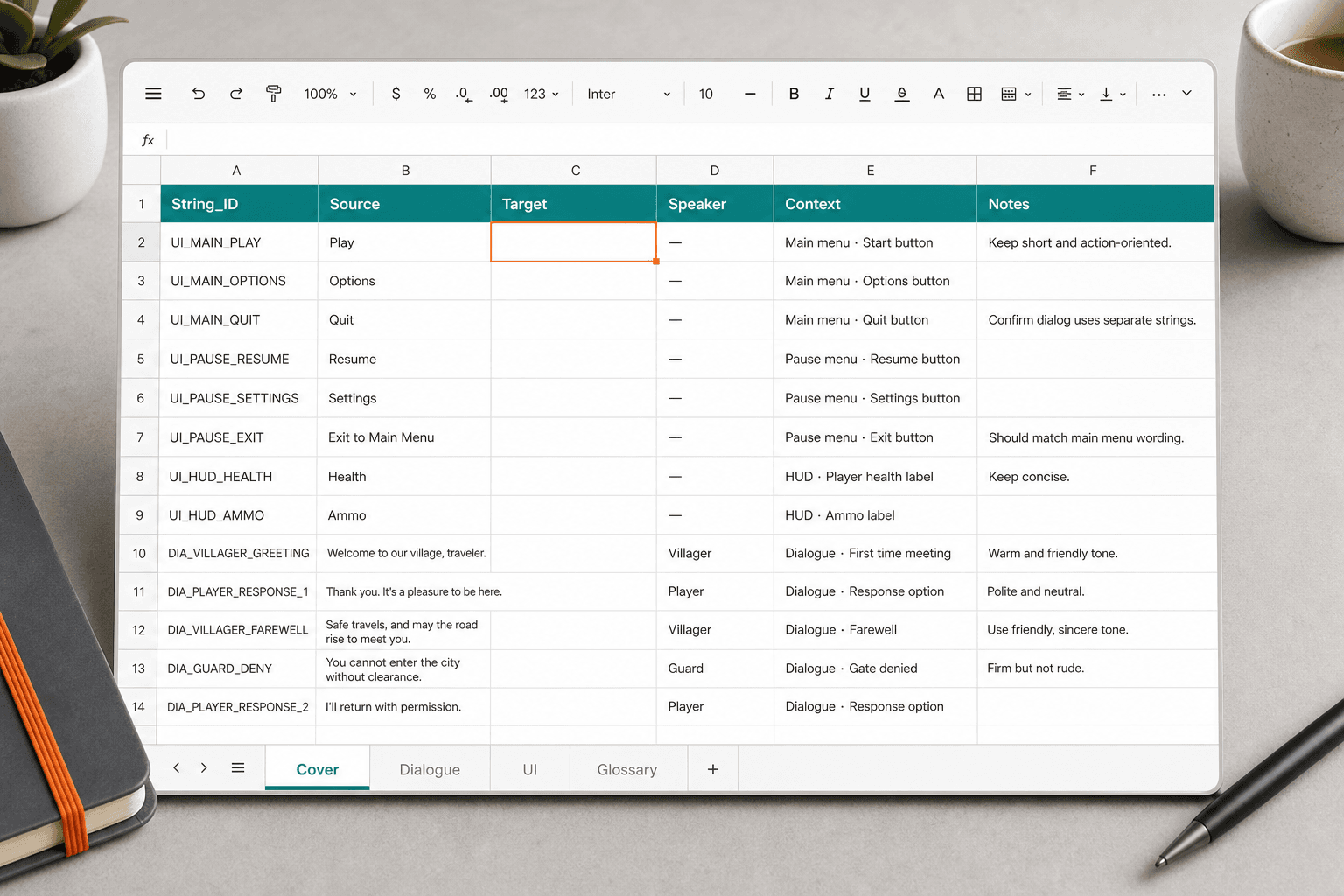
Core summary of an ideal Loc Kit
1) Recommended column schema
Keep the same column layout across every sheet/tab (
UI,Dialogue,System). Even on a UI sheet with no speaker data, leave the speaker column empty — do not delete it.
| String_ID | Speaker | Addressee | Context | Source | Target | Notes | Next_String_ID |
String IDs are required later when you merge translations back into the game. Lines with order — dialogue, narration, sequential copy — must follow in-game output order. Dialogue often branches, so use Next_String_ID (or an equivalent marker) to show which line follows after each branch.
2) A 10-second Loc Kit checklist
Before you hand the file to a translator or agency, check these seven items:
- Universal format: Can someone open it without a paid specialty tool?
- Cover / README tab: Are global rules included (tone, tag rules, contact path)?
- Chronological order: Is dialogue sorted in real in-game output order?
- Unified column schema: Do all tabs share the same columns (
Source,Target,ID, etc.)? - UI / ambiguous words: Do short strings like
PlayorSavecarry aContextlabel? - Speaker marked: Is
Speakerfilled on dialogue lines? - Tags & variables preserved: Do codes like
{0}and<Color>remain inside the Source cell?
The first job in game localization is extracting in-game source text into a workable file. For that file to function as a real localization kit (Loc Kit), you need to know what a Loc Kit is — and how to build one so localization specialists can work efficiently.
This article lays out a practical Loc Kit baseline that studios, agencies, and community teams can share regardless of which localization tools they use. There is no single required format — Google Sheets, Excel, or CSV can all work. What decides whether a Loc Kit is good is whether it is structured so each line’s output context is readable. This feature walks through what that structure looks like in practice.
What a Loc Kit is for
A Loc Kit is a working table of translatable strings plus the metadata needed to translate them correctly. Freelancers and localization teams use different CAT (Computer-Assisted Translation) tools and pipelines, so a universal format anyone can open is the safer default. It is also common to keep everything in one spreadsheet document so people do not have to bounce between many files. (This article assumes a spreadsheet-style Loc Kit.)
Translation happens row by row, but meaning is not finished inside a single row. What a line means depends on the scene where it appears, whether it is UI or dialogue, who is speaking and listening, and what comes before and after. A short example: in one Loc Kit, Back arrived with no extra context, so the translator rendered it as a UI “go back” action — when in-game it meant the equipment slot on a character’s back. In dialogue, missing speaker or addressee often lets tone and nuance drift. Even a short line like Hey can go in different directions depending on who says it to whom, and in what situation — which is why output order and readable context matter.
How to build each column
A Loc Kit should present its data clearly, with each kind of information living in its own spreadsheet column.
- At minimum you need Source and Target. Target is empty before localization work begins; the other columns exist to raise the quality of what fills that blank. One rule is non-negotiable: every line must stay in chronological order — real output / reading order. When dialogue branches, mark what follows after each branch using line numbers or similar identifiers. If a source sentence is split across multiple strings, those fragments must stay contiguous in time order. (If you care about multilingual support, splitting one sentence across strings is better avoided from the start.) When one unit is scattered across the Loc Kit, sentence-level translation becomes impossible. A Loc Kit with no readable output order cannot be translated properly by anyone; translators end up jumping between corrections and in-game checks, which raises cost and lowers quality.
- Beyond Source and Target, a few columns almost always earn their keep. Row Key / String_ID identifies each row. When file, scene, or quest cues live in the key, translators can often infer context from the ID alone without opening a build.
- For dialogue files, a Speaker column improves quality a great deal. Some teams split each character onto a separate sheet. Even then, if a scene has two or more NPCs, keep the other speakers’ lines on that same sheet — it helps translation quality far more than isolating one voice.
- A Context column, filled when needed, also helps. Useful notes include a short situation blurb at the start of a dialogue chunk, a reminder that a line is UI (often the sheet name is enough for that), or — in games with character portraits — the expression set when the line plays.
- Helpful extras include Addressee, scene notes, and Max length when a string has a byte/character cap (that reduces later LQA effort). Utterance type (monologue, thought, conversation, and so on) also helps. Addressee can often be inferred when order is solid and Speaker is filled, so it is sometimes optional — but if three or more people share a scene, or branching makes roles easy to confuse, fill it when you can.
- Put global rules and useful links on the cover sheet or README. Tag / variable preservation rules must be explicit. Tone, honorifics, banned terms, terminology and lore, a contact channel, and a short “how to read this Loc Kit” note are strong additions.
Once you know this structure, you also know what to avoid: putting non-source information in the Source column, shipping a Loc Kit with no headers, or sorting lines by filename or alphabet. That last pattern is especially common when the extraction pipeline is weak.
Many sheets are fine — mismatched structure is not
Working Loc Kits often have multiple sheets in one file. One sheet is nicer when possible, but multiple sheets are not a problem by themselves. Changing the column layout sheet by sheet usually is. Keep the same column structure across every sheet; leave unused cells empty, but keep the columns. An empty Speaker column on a UI sheet is better than a missing one. Freeze one template per project. Different columns per sheet create avoidable work in CAT migration, QA, and handoff.
Game translation often uses CAT tools to protect placeholders/tags and terminology consistency. Design the Loc Kit so Source and Target map cleanly for that workflow. Keep one Source–Target structure throughout the file. If the kit is multilingual, give each language the same Target column layout across every sheet.
Context as a label, not a novel
Unless more detail is truly needed, keep Context short. Simple labels like UI or Setting are often enough. Add thicker notes only when a string can be read more than one way.
Dialogue needs a little more care. At the start of each dialogue chunk, note what is happening, and briefly mark when — or under what condition — each line fires. When lines are in time order and chunk notes are present, translators can often follow the flow without launching the game.
Fill Speaker, and put a one-line voice summary for each character on the cover. Addressee helps a lot when localizing into languages with speech hierarchy (Korean, Japanese, Russian, and others).
A good Loc Kit shows in the cover and headers
Put together, a well-built Loc Kit usually has these traits: (1) it is shared in a universal format, (2) the cover carries global guidance, (3) every sheet uses the same structure, (4) dialogue follows in-game output order and marks where each branch continues, with split sentences kept together, (5) String IDs are present, (6) short or ambiguous UI has Context, (7) dialogue chunks open with a situation note, (8) Speaker is present so character voice stays consistent, and (9) tag, variable, and length rules are documented.
Weak Loc Kits show the opposite patterns: output order ignored, keys or context accidentally sitting in Source, mismatched sheet structures, missing tags or placeholders (which can crash the game on reimport or break intended display). Among these, chronological collapse is the most common extraction failure — and a leading cause of mistranslation.
Loc Kit quality sets the ceiling on localization quality
A good Loc Kit is more than extracted strings in one file. It is a context blueprint that lets translators work without staring at the screen — seeing where a string appears and what surrounds it. Keep in mind that Loc Kit quality steers localization quality.
To put it plainly: Loc Kit quality sets the upper bound on localization quality. Meet the conditions above and you raise the ceiling of the final result — and you greatly reduce the chance that freelancers, translation teams, or agencies will say they cannot start without more context or extra resources.
'이상적인 현지화 키트'의 핵심 요약
1) 표준 컬럼 스키마 예시 (가장 권장하는 구조)
모든 시트/탭(
UI,Dialogue,System)에 걸쳐 아래와 동일한 열 구조를 유지하세요. 예컨대 UI 관련 시트라서 화자 관련 데이터가 없더라도 열을 삭제하지 않고 비워두는 것이 좋습니다.
| String_ID | 화자 | 청자 | 맥락 | 원문 | 번역어 | 노트 | Next_String_ID |
String ID는 추후 현지화 키트에서 번역한 번역문을 다시 게임에 통합할 때 필요합니다. 순서가 있는 대사나 글귀 같은 경우 반드시 인게임 출력 순서대로 배치하여야 하며, 대사의 경우 분기가 있는 경우가 흔하므로 Next_String_ID나 그에 준하는 식별자를 통하여 각 분기 후 어떤 대사로 이어지는지 알 수 있게 명시해두면 좋습니다.
2) 좋은 현지화 키트 10초 체크리스트
파일을 번역가나 에이전시에 넘기기 전, 다음 7가지를 점검하세요.
- 범용 포맷: 별도의 유료 툴 없이도 열어볼 수 있는 포맷인가?
- 표지(README) 탭: 전역 지침(톤앤매너, 태그 규칙, 문의처)이 포함되어 있는가?
- 출력 순서(Chronological Order): 대사가 게임 내 실제 출력 순서대로 정렬되어 있는가?
- 컬럼 스키마 통일: 모든 탭의 열 구성(
Source,Target,ID등)이 동일한가? - UI/중의어 맥락:
Play,Save같은 짧은 단어에Context라벨이 붙어 있는가? - 화자 지정: 대사 라인에
Speaker가 입력되어 있는가? - 태그·변수 보존:
{0},<Color>등의 코드가 원문(Source) 셀에 그대로 들어있는가?
게임 현지화 과정에서 가장 먼저 할 일은 게임 내에서 출력되는 텍스트 원문을 별도의 가공 가능한 파일로 뽑아내는 일입니다. 다만 이렇게 추출한 파일이 제대로 된 현지화 키트(localization Kit, 혹은 Loc Kit) 노릇을 하게끔 하려면 현지화 키트란 무엇이며, 어떻게 현지화 키트를 꾸려야 현지화 전문가가 가장 작업하기 좋은지 알아둘 필요가 있습니다.
이 글은 게임 현지화 작업을 준비하는 스튜디오·에이전시·커뮤니티 팀이 사용 중인 각종 현지화용 툴에 상관없이 공유할 수 있는 Loc Kit의 실무 기준을 정리합니다. 구글 시트든 엑셀 파일이든 CSV든 현지화 키트를 꾸리는 데에 있어서 정해져 있는 포맷은 없습니다. 각각의 원문이 어떠한 맥락에서 출력되는 말인지 알아볼 수 있는 구조로 현지화 키트를 준비해두는 것이 좋은 현지화 키트인지 아닌지를 판가름합니다. 이번 특집 기사에서는 이러한 좋은 현지화 키트는 어떤 식으로 꾸려져 있는지 살펴보고자 합니다.
Loc Kit은 무엇을 위한 파일인가
Loc Kit은 번역 대상 문자열과, 그걸 제대로 번역하는 데 필요한 메타데이터를 모은 작업용 표입니다. 현지화 팀이나 프리랜서마다 사용하는 CAT(Computer-Assisted Translation) 툴 등 번역에 사용하는 파이프라인이 다르기 때문에 누구나 열 수 있는 범용 포맷으로 준비해두는 편이 좋습니다. 또한 각종 데이터를 여러 파일을 오가며 확인하지 않아도 되게끔 하나의 문서 안에 일목요연하게 정리할 수 있게끔 스프레드시트 형식의 문서에 정리하는 편이 일반적입니다. (본 기사에서 다루는 현지화 키트도 기본적으로 스프레드시트 형식을 상정하고 있습니다)
번역은 행 단위로 진행되지만, 의미는 행 안에서만 완성되지 않습니다. 각 행이 지니고 있는 의미는 해당 행의 원문이 어떤 장면에서 출력되는지, UI인지, 대사라면 화자와 청자는 누구인지, 앞뒤 대사는 어떻게 되는지 등등에 따라 현저하게 달라집니다. 짧은 오역 사례로 Back 이란 단어가 추가 맥락 없이 제공된 한 현지화 키트에서 담당 번역가는 해당 단어를 '뒤로 가기'로 번역하였으나, 사실 저 단어는 인게임에서 아이템 장착 위치 중 등을 지칭하는 말이었습니다. 대사의 경우 화자나 청자가 명시되어 있지 않으면 현지화 과정에서 어투나 뉘앙스가 흔들리는 경우가 많습니다. Hey 같은 짧은 대사도 어떤 상황에서 누가 누구에게 내뱉느냐에 따라 번역의 방향성이 갈리므로 대사의 출력 순서와 각종 정보를 알아볼 수 있는 맥락 정보가 중요합니다.
현지화 키트의 각 열(column)의 구성 방법
현지화 키트에는 앞서 살펴본 것처럼 여러가지 데이터가 일목요연하게 정리되어 있어야 하며, 각각의 데이터는 스프레드시트의 각 열에 기록해 두게 됩니다.
- 우선 현지화 키트에는 최소한 Source와 Target 열이 필요합니다. Target은 현지화 팀의 작업을 거치기 전에는 당연히 공란이며, 이 공란에 채워질 내용의 질을 높이기 위한 여러 맥락 정보가 다른 열에 채워지게 됩니다. 또한 한 가지 반드시 지켜져야 하는 규칙이 있다면 모든 라인은 chronological order, 즉 실제 출력·읽기 순서로 정렬되어 있어야 한다는 것입니다. 출력 순서에 분기가 발생하는 경우 각 대사별 라인 번호 등의 식별자를 토대로 어떤 분기 후에 어떤 대사로 이어지는지 표시를 해줄 필요가 있습니다. 원문의 문장이 여러 스트링으로 쪼개졌다면 그 조각은 반드시 시간 순으로 연속해서 기입되어 있어야 합니다.(사실 한 문장을 여러 스트링으로 쪼개는 것은 게임의 다국어 지원을 고려하고 있다면 애초부터 피하는 편이 좋습니다) 이렇게 하나의 덩어리가 loc kit 내에서 찢어지면 문장 단위 번역이 불가능해집니다. 출력 순서를 알 수 없는 loc kit은 그 어떤 번역 전문가도 제대로 번역해낼 수 없으며, 사후 교정이나 인게임 확인 등 맥락 전환을 해가면서 번역을 해야 하므로 비용 증가, 품질 저하 등으로 이어지게 됩니다.
- Source와 Target 열 외에도 거의 항상 제값을 하는 열이 있습니다. Row Key / String_ID는 번역할 각 데이터의 식별자 역할을 합니다. 파일·씬·퀘스트 정보가 키에 녹아 있으면 빌드를 열지 않아도 번역가가 키값만 보고도 맥락을 짐작할 수 있습니다.
- 대사 관련 파일을 정리할 때는 Speaker관련 정보를 담고 있는 열이 있으면 번역의 품질이 크게 개선됩니다. 간혹 각 인물의 모든 대사를 시트별로 나눠 놓는 경우가 있습니다. 이런 경우라도 npc가 2명 이상 등장하는 장면이 있다면 다른 npc의 대사도 해당 시트에 정리해 두는 편이 번역 품질 향상에 크게 도움이 됩니다.
- Context열을 꾸려두고 필요한 경우 설명을 기입해 두면 역시 번역 품질 향상에 도움이 됩니다. 각 대화 청크 맨 앞에서 어떤 상황인지 설명해 준다든지, 이건 게임 UI에서 출력되는 라인이라든지(이렇게 짧은 맥락의 경우 보통 시트 이름만으로도 충분합니다), 캐릭터 초상화가 함께 출력되는 게임이라면 해당 라인 출력 시 캐릭터의 표정은 어떻게 설정되어 있는지 등등의 정보를 context에 넣어주면 좋습니다.
- 있으면 도움이 되는 열로는 Addressee(청자), 장면 설명 등이 있고 각 스트링의 출력 바이트에 제한이 있을 경우 Max length를 기입해줘야 추후 LQA에서 들어갈 공수가 줄어들게 되며, 발화 유형(독백인지, 생각인지, 대화인지 등등)이 명시되어 있으면 역시 번역에 도움이 됩니다. 청자의 경우 출력 순서가 제대로 정렬되어 있고, 화자가 명시되어 있는 경우 명확하게 추론 가능한 경우가 많으므로 생략 가능하지만, 한 장면에 화자가 3명 이상이 등장한다든지 분기가 여러 개라 헷갈릴 여지가 있는 경우에는 가능하면 기입해 주는 편이 좋습니다.
- 맨 앞 — 표지 시트나 README — 에 전역 규칙이나 각종 유용한 링크를 제공해 주면 매우 좋습니다. 태그·변수 보존 관련 규칙은 반드시 명시해 주어야 하며, 톤앤매너, 존비어, 금지어, 용어 및 세계관, 문의 채널, 그리고 “이 Loc Kit을 읽는 법” 정도가 추가로 있으면 좋습니다.
이러한 구성 방법을 숙지하고 나면 자연스럽게 어떤 식의 현지화 키트 구성을 피해야 하는지도 알 수 있게 됩니다. 원문 열에 원문이 아닌 다른 정보 넣어두기, 헤더 없는 현지화 키트, 파일명이나 알파벳 순으로 원문을 섞어 두기 등입니다. 특히 마지막 경우는 원문 추출 파이프라인이 제대로 꾸려져있지 않다면 매우 흔하게 나타나는 유형입니다.
시트는 여러 개여도, 각 시트의 구조는 통일되어 있어야 한다
실무에 쓰이는 현지화 키트의 경우 한 파일에 시트가 여러 개인 경우가 많습니다. 시트가 기왕이면 하나인 편이 좋지만, 시트가 여러 개라고 해서 문제가 될 것은 없습니다. 다만 시트마다 열 구성을 바꾸는 것은 문제가 되는 경우가 많습니다. 각 열의 구조는 전 시트 동일하게 두고, 필요 없는 값은 비우되 열 자체는 유지하는 편이 좋습니다. UI 시트에서 Speaker가 비어 있어도 Speaker 열은 있는 편이 낫습니다. 하나의 프로젝트에 할당된 템플릿은 하나로 고정하세요. 시트마다 열이 달라지면 CAT 툴 마이그레이션·검수·인수인계 등 모든 과정에서 불필요한 추가 공수가 들어갑니다.
게임 번역의 경우 플레이스홀더 / 태그 처리 및 용어의 일관성 보존을 위해 CAT툴을 쓰는 경우가 많은데, 이를 위해서라도 Source와 Target열이 일관되고 깨끗하게 매핑되도록 현지화 키트를 설계하도록 합시다. 한 파일 내에 Source–Target 구조는 하나로 통일하세요. 다국어 번역을 염두에 둔 loc kit이라면 각 언어에 해당하는 Target 열을 각 시트에 걸쳐 동일하게 구성하세요.
Context는 소설이 아니라 라벨처럼
Context는 꼭 필요한 경우가 아니라면 짧게 씁니다. 'UI' 라든지 'Setting'등 간단한 단어만으로도 충분한 경우가 많습니다. 중의어로 보일 여지가 있는 경우에만 추가 맥락을 제공합니다.
대사 쪽은 조금 더 손이 갑니다. 각 대화 청크의 시작점에 지금 무슨 상황인지 적고, 각 라인이 언제·어떤 조건에서 출력되는지를 짧게 남기면 매우 큰 도움이 됩니다. 대사가 시간순으로 정렬되어 있고 청크 메모가 함께 있으면, 번역가가 게임을 켜지 않아도 게임 내 대사의 흐름을 따라갈 수 있는 경우가 많습니다.
Speaker를 채우고, 표지에는 캐릭터별 말투를 한 줄로 요약해 둡니다. Addressee를 두면 어투의 위계가 있는 언어로의 현지화에 크게 도움이 됩니다(한국어, 일본어, 러시아어 등).
‘좋은 Loc Kit’은 파일 표지와 헤더만 봐도 바로 구분할 수 있다
이상을 토대로 잘 꾸려진 현지화 키트의 특징을 요약해 보자면 좋은 현지화 키트란 1. 범용 포맷으로 공유되고, 2. 표지에 전역 지침이 있으며, 3. 전 시트의 구조가 같고, 4. 대사의 경우 인게임 출력 순서 및 각 대화 분기가 어디로 이어지는지 마커나 식별자를 통해 표시해 주며 쪼개진 문장이 있을 경우 반드시 붙여 두었으며, 5. String ID가 있고, 6. 짧거나 중의적인 UI에는 Context가 있으며, 7. 각 대사 청크 시작점에 상황 메모가 있는 키트라고 할 수 있습니다. 또한 8. 각 캐릭터들의 성격과 어투를 일관되게 유지할 수 있게끔 Speaker가 있고, 9. 태그·변수·길이 규칙이 문서화되어 있어야 합니다.
반대로 나쁜 현지화 키트에서는 다음과 같은 패턴이 나타납니다. 인게임에서의 출력 순서가 지켜지지 않은 키트, Key나 맥락이 실수로 Source에 들어간 경우, 구조가 제각각인 시트를 모아둔 키트, 태그나 플레이스홀더가 빠져있는 시트(현지화 파일 적용 시 게임 크래시의 원인이 되거나 각 스트링이 의도된 대로 출력되지 않게 됩니다) 등을 꼽을 수 있습니다. 그중에서도 시간순 정렬 붕괴는 추출 실무에서 가장 흔하게 나타나는 패턴이며, 오역의 주된 원인입니다.
Loc Kit의 품질이 현지화 품질의 상한선을 결정한다
좋은 Loc Kit이란 단지 게임 내 출력 문자열을 뽑아내서 하나의 파일에 담아내는 것만으로는 부족하고, 번역가가 화면을 보지 않고도 해당 문자열이 게임 내 어디서, 어떤 맥락에 출력되는지 파악하며 번역해 나갈 수 있는 맥락 설계도입니다. 현지화 키트의 품질이 곧 현지화 품질을 좌우함을 명심하여 주세요.
재차 강조하지만 현지화 키트의 품질은 현지화 결과물 품질의 상한선을 좌우합니다. 위에서 열거한 좋은 현지화 키트의 조건을 충족한 키트를 꾸리면 현지화 품질이 크게 향상됨은 물론이고 프리랜서, 번역 팀, 에이전시 등으로부터 “추가 맥락 설명이나 리소스 투입 없이는 시작할 수 없다”는 말이 나올 여지가 크게 줄어듭니다.
Enjoyed this article?
Share this story or copy a neatly formatted summary with one click.
Comments
Sign in with your GitHub account to leave comments, feedback, or emoji reactions.